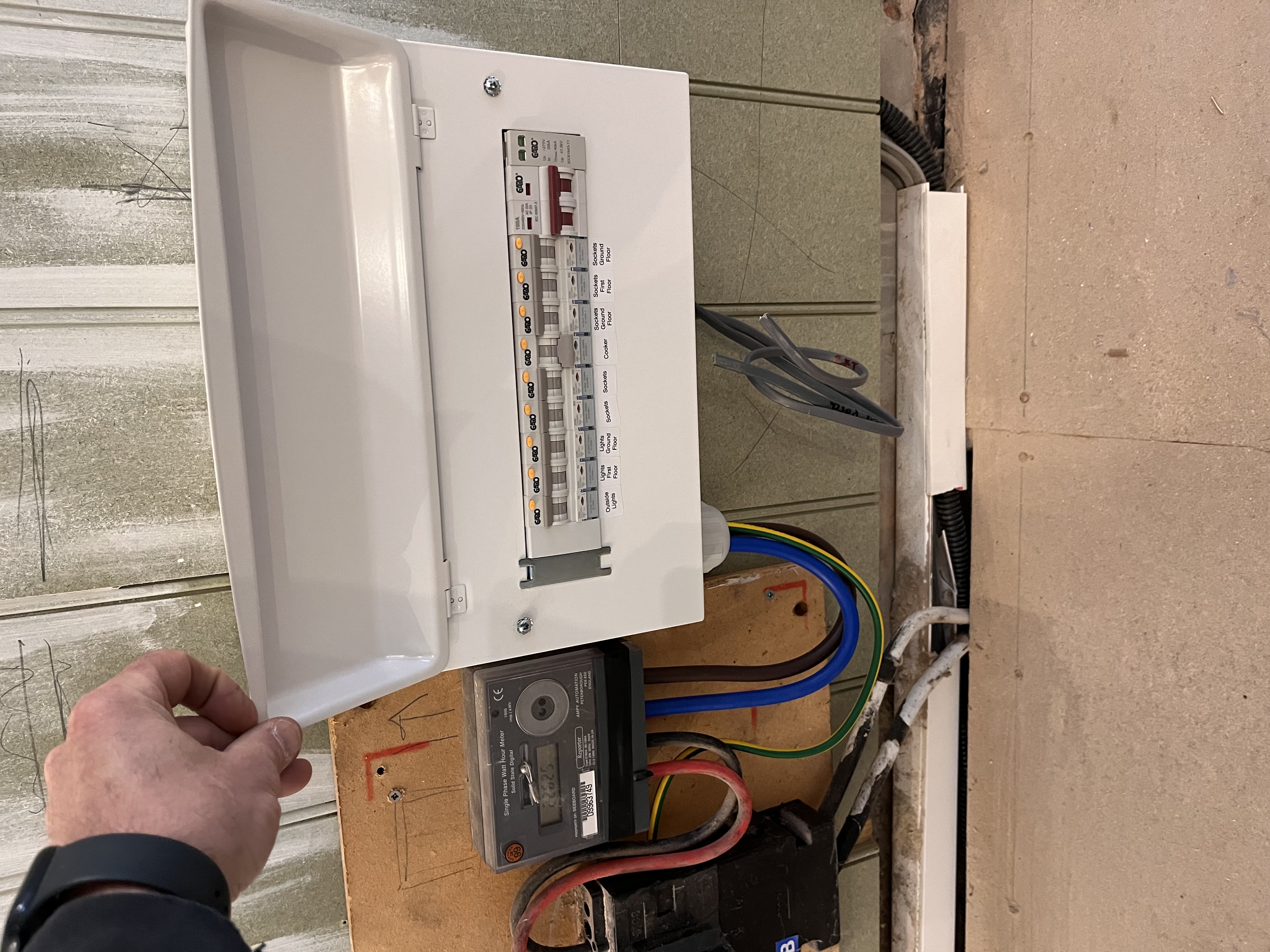
The consumer unit (the "fuse board") is the brain of your electrical installation. It splits the incoming supply into separate circuits, protects each one against faults and overload, and trips the supply if something goes wrong. A modern board with RCD or RCBO protection on every circuit is one of the most cost-effective safety upgrades you can make to an older home, and it's increasingly expected by buyers, lenders, and EICR inspectors.
Warning Signs Your Board Needs Upgrading
You don't need to know the regulations to recognise an out-of-date board. The visible signs are pretty consistent:
- Plastic enclosure: Older plastic-clad boards have been associated with fires when a loose connection generates heat that the casing can't contain. Since 2016, all new installations require a metal-clad enclosure. If yours is plastic, it's a sensible upgrade.
- Rewireable fuses (or "wire fuses"): If you can see a row of porcelain holders with thin fuse wire running across them, that's a generation behind current practice. They protect against overload but don't trip fast enough for modern faults, and they don't include RCD protection.
- No RCD protection on lighting or sockets: If only some circuits have an RCD (or none do), the rest of the installation has no fast-acting earth fault protection. The 18th Edition expects RCD protection on every final circuit.
- Patched-up additions: If you can see extra breakers added to the side, surface-clipped junctions, or different brands stacked together, the installation has likely been added to over the years rather than redesigned.
- Marked failure on a recent EICR: Inspectors regularly classify out-of-date boards as a C2 (potentially dangerous), which usually triggers a recommendation to upgrade.
What's Changed Since the 18th Edition
The 18th Edition of the wiring regulations came into force in 2019 and was amended in 2022. The most relevant changes for consumer units are:
- Metal enclosures: All new and replacement consumer units in domestic premises must be in a non-combustible (metal) enclosure.
- RCD protection on every final circuit: Every socket and lighting circuit in a domestic installation should have 30mA RCD protection. RCBOs (combined RCD + breaker per circuit) are now the standard way to deliver this without nuisance tripping.
- Surge protection: Surge Protection Devices (SPDs) are now required for new installations and recommended for upgrades, particularly for properties with sensitive electronics or in rural areas.
- Arc fault detection (AFDDs): Increasingly recommended for higher-risk premises and now mandatory in some specific contexts (e.g. care homes). Worth discussing if you're particularly safety-focused.
What an Upgrade Involves
Most domestic consumer unit replacements are a one-day job. The sequence is:
- Survey and quote: Quick visit to confirm the existing meter tails, identify each circuit, and measure the available space. We quote a fixed price.
- Isolation: The supply is switched off at the main isolator before any work begins.
- Old board removal: The existing fuse board is disconnected and removed. We salvage the meter tails and main switch where they're still in good condition.
- Insulation testing: Before the new board is energised, every circuit is tested for insulation resistance, polarity, and earth continuity. Any borderline issue is identified now, not after the new board is live.
- New board installation: The new metal-clad consumer unit is fitted, with a dedicated RCBO on every circuit. Each breaker is labelled clearly.
- Re-energise circuit by circuit: Power goes back on one circuit at a time so any nuisance trip can be diagnosed straight away.
- Sign-off: Electrical Installation Certificate, Part P notification, and a printed circuit chart for the front of the board.
Need a Consumer Unit Upgrade?
Call JMA Electrical on 07850 965753 for a free quote across Steyning, Lancing and Sussex.
Call for a Free QuoteCost Guide
A typical domestic consumer unit upgrade is between £550 and £850. The variables that move the price are:
- Number of circuits: A 6-way board is cheaper than a 12-way. Most homes land between 8 and 12 circuits.
- RCBO vs RCD-and-breaker design: Per-circuit RCBO is the gold standard and slightly more expensive than the older split-load RCD design. We strongly recommend RCBO for the lifetime resilience, but the older design is still compliant.
- Brand: Hager and Wylex are common UK choices and similarly priced. MK and Eaton are also reliable. Cheap unbranded boards are a false saving.
- Supplementary work: If the meter tails are too short, the main earth needs replacing, or the SPD adds another module, expect the price to creep up by £50-£150.
Certification You Should Get
At the end of the upgrade you should receive:
- Electrical Installation Certificate (EIC): The formal document recording the installation, the test results, and the installer who signed it off.
- Part P Building Regs compliance: Notifying Building Control on your behalf is part of the job for an NICEIC-registered installer. The compliance letter follows in the post within a few weeks.
- Circuit chart: A printed label or sheet showing which RCBO covers which circuit, fixed to the front of the new board. Saves you guessing the next time you need to isolate a circuit.
- NICEIC-backed warranty: A six-year guarantee on the workmanship via the NICEIC's scheme.
Keep all of the paperwork together with the property file. You'll need it for any future EICR, for any sale, and to validate the warranty.
Frequently Asked Questions
Typically a few hours during the swap itself, with shorter on/off cycles during testing. We tell you the rough window when we arrive so you can plan around it (defrost the freezer pre-emptively, don't leave food on a slow cooker, that kind of thing).
Clear access to the existing board (move shoes, coats, or whatever's in front of it), and ideally have a list of which circuit covers what if you already know. Otherwise we'll work it out during the survey.
That's exactly what the testing is for. If we find a borderline insulation reading or a polarity issue on a specific circuit, we'll explain it, quote any remedial work separately, and fix what we can on the same visit before signing off the new board.
RCBOs per circuit are designed specifically to avoid the nuisance trips that older split-load boards used to cause. If a single appliance has a borderline earth leakage problem, the RCBO will trip only that circuit, and you can identify the culprit appliance much more easily than before.
Not strictly. The pre-energise testing we carry out as part of the upgrade is similar in scope to an EICR for the existing circuits, and we issue an Electrical Installation Certificate at the end. If you want a full periodic inspection report on top, we can carry one out separately.
Yes. Six-year NICEIC-backed workmanship guarantee on the install, plus the manufacturer's warranty on the consumer unit and breakers themselves (typically two to five years depending on brand).